
If you are asking about a completed event, use “What happened?” The word happened is the simple past form of happen, so it correctly refers to something that occurred in the past.
For example:
- What happened yesterday?
- What happened at the meeting?
By itself, “What happen?” is not the standard way to ask about a past event. However, happen is not incorrect in every question. It is the base form and works correctly after auxiliary or modal verbs such as will, might, and did.
What will happen next?
What might happen if we wait?
What did happen after that?
The key is to look at the whole grammatical structure, not just the verb. If you are choosing between what happen or what happened, first consider whether you are asking about the past, present, or future. That simple distinction will help you select the correct form and avoid common tense errors.t the verb.
Quick Answer: “What Happened” or “What Happen”?
Use the past form when you mean “What occurred?” in the past. The table below shows how the form changes with the meaning.
| Form | Use | Example |
|---|---|---|
| What happened? | Past event | What happened yesterday? |
| What happens? | Present or general event | What happens next? |
| What will happen? | Future event | What will happen tomorrow? |
| What might happen? | Possible event | What might happen if we wait? |
| What did happen? | Past event with emphasis | What did happen after that? |
So, if someone tells you about an incident that has already occurred, ask:
What happened? ✅
Do not ask:
What happen? ❌
What Does “Happen” Mean?
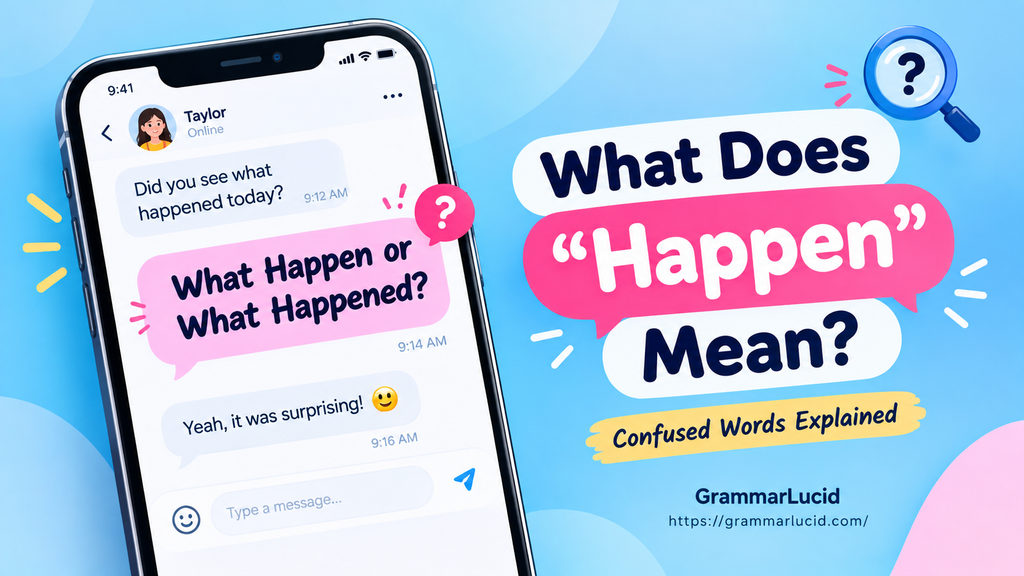
Happen means to take place or occur. It is the base form of the verb.
For example:
- Accidents happen.
- Something unusual may happen.
- What will happen next?
The form changes according to the grammatical structure and the meaning you want to express.
The Base Form “Happen”
Happen is the base form of the verb. You commonly see it after modal verbs and after did in past-tense questions.
Examples include:
- What will happen next?
- What might happen if we leave now?
- What can happen in this situation?
- What did happen after the meeting?
After will, might, and can, the verb stays in its base form. Likewise, when did carries the past tense in a question, the main verb remains in its base form.
That is why we say:
What did happen? ✅
rather than:
What did happened? ❌
The Past Form “Happened”
Happened is the simple past form of happen. Use it when you are referring to something that occurred in the past:
- Something strange happened last night.
- The accident happened near the station.
- What happened after the class?
Notably, the past form can appear without did when the question is a subject question.
Why “What Happened?” Is Correct
This is a standard English question about a past event. Here, what functions as the subject, and happened is the past-tense verb. As a result, English normally does not use an auxiliary before the subject when a wh-word such as what or who is the subject.
How the Question Is Structured
The structure is simple:
What + happened?
You can see this more clearly by starting with a statement:
Something happened.
If you do not know what that “something” was, replace it with what:
What happened?
In this case, what is the subject of happened. That is why you do not need did.
Compare the following pair:
Sarah broke the glass. Who broke the glass?
In the second sentence, who replaces the subject Sarah, so there is no need for did. This pattern is called a subject question.
Why “Happened” Shows Past Time
Happened is the simple past form, so it presents the event as something that occurred in the past.
For example:
What happened last night?
Here, the phrase last night clearly places the event in the past.
However, a time expression is not always necessary:
You look worried. What happened?
In that situation, the surrounding context makes the past meaning clear.
Why “What Happen?” Is Usually Incorrect
“What happen?” is usually incorrect when you are trying to ask about a past event. The problem is that happen is the base form and does not mark the past in this standalone structure.
Compare these two versions:
❌ What happen yesterday? ✅ What happened yesterday?
Clearly, the second sentence uses the past form required for the completed event.
The Problem With Using the Base Form Alone
The base form happen can be correct, but it needs the appropriate grammatical structure.
For example:
- What will happen next?
- What might happen if we cancel?
- What did happen after the announcement?
In these examples, will, might, or did provides the structure that allows happen to remain in its base form. Without that structure, however, “What happen?” does not normally express a standard past-tense question.
Why “What Happen?” Does Not Work for a Past Event
English does not normally use the base form alone to ask about a completed past event.
Compare the earlier pattern with a general one:
Something happens regularly. What happens regularly?
As you can see, the verb form changes because the meaning changes. Happened points to a past event, while happens refers to something that occurs in the present or generally.
When “Happen” Is Correct in a Question
The word happen is perfectly grammatical in several question structures. Let us look at each one.
“What Happens?” for Present or General Situations
Use “What happens?” when asking about something that occurs regularly, generally, or as part of a process.
- What happens after you submit the form?
- What happens if the machine stops?
- What happens next?
In these questions, happens is the present-tense form because what is the subject.
“What Will Happen?” for Future Events
Use “What will happen?” when asking about a future event.
- What will happen tomorrow?
- What will happen if we cancel the order?
- What will happen after the test?
Here, the modal auxiliary will is followed by the base form happen, not happened.
“What Might Happen?” for Possible Situations
Use “might happen” when discussing a possibility rather than stating that an event definitely will occur.
- What might happen if we wait?
- What might happen during the storm?
Again, might is followed by the base form happen.
“What Did Happen?” for Emphasis
“What did happen?” is grammatical, but it is more emphatic than the neutral question in the past simple.
For example:
You said nothing went wrong. So what did happen?
In this sentence, did adds emphasis. Cambridge Grammar notes that speakers can use do for emphasis in wh-questions, including questions in which the wh-word is the subject.
Why This Question Does Not Need “Did”
Many learners know that did commonly appears in past-tense questions. For that reason, the question can seem unusual. The key, however, is to identify the subject.
Subject Questions Explained
In this question, what is the subject. The underlying statement is:
Something happened.
Replace the unknown subject with what, and the question is complete. Because what is already the subject, there is no need for the usual did auxiliary. In fact, Cambridge Grammar specifically explains that when a wh-word is the subject, English does not normally use an auxiliary in this structure.
“What Happened?” vs. “What Did You See?”
To illustrate the difference, compare the subject question above with this one:
What did you see?
In the subject question, what is the subject. In this second question, on the other hand, you is the subject and what is the object:
You saw something. What did you see?
Because you is the subject, the question uses did, and the main verb remains in its base form: see, not saw. Thus, the subject-versus-object distinction explains why these two question patterns look different.
What Happened vs. What Happens vs. What Will Happen
These questions look similar, but they refer to different situations.
| Question | Meaning |
|---|---|
| What happened? | Past event |
| What happens? | Present or general event |
| What will happen? | Future event |
| What might happen? | Possible event |
A useful approach is to decide when or under what conditions the event occurs before choosing the verb form.
How Context Helps You Choose the Right Form
Past Time and Completed Events
Use happened when you are asking about something that already occurred.
- What happened at the party?
The event could have occurred recently or long ago. What matters is that you treat it as a past occurrence.
Present or General Situations
Use happens when the question concerns something that occurs regularly, generally, or as part of a process.
- What happens when the battery runs out?
- What happens after this step?
These questions do not ask about one completed event. Instead, they ask what normally or generally occurs.
Future and Hypothetical Situations
Use will happen for a future event:
What will happen after the meeting?
Similarly, use might happen when discussing a possibility:
What might happen if the plan fails?
In both cases, the base form happen is correct after these modal verbs.
Time Markers That Signal the Past
Certain words and phrases often point toward the simple past:
- yesterday
- last night
- last week
- earlier
- a few minutes ago
- after the meeting
- when you arrived
Along these lines, the British Council notes that the past simple is commonly used with expressions such as ago for past events.
Common Mistakes With “Happen” and “Happened”
“What Happen?” Instead of “What Happened?”
The problem here is the use of the base form for a past event.
❌ What happen yesterday? ✅ What happened yesterday?
Therefore, if you are asking about a completed event, use happened.
“What Did Happened?” Instead of “What Did Happen?”
This mistake uses both did and the past form happened:
❌ What did happened? ✅ What did happen?
Since did already carries the past tense, the main verb stays in its base form. The same pattern appears in:
She went home. Did she go home?
Likewise, the principle applies to happen:
It happened yesterday. What did happen yesterday?
Additionally, the British Council describes the past-question pattern as did + subject + base verb when an auxiliary is needed.
Mixing Past, Present, and Future Forms
Another common mistake is choosing a verb form that does not match the intended time.
❌ What happened tomorrow? ✅ What will happen tomorrow?
❌ What happen next? ✅ What happens next?
Before choosing the verb, identify whether you mean the past, present, future, or a possible situation.
This Question in Everyday English
Asking About an Unexpected Event
You can use this question when something unusual has occurred.
You look upset. What happened?
In this case, the question asks what occurred before or around the situation you are observing.
Asking What Occurred in a Situation
You can also use it to ask for information about an event:
- What happened during the interview?
Regardless of timing, the same structure works whether the event occurred recently or much earlier.
Asking About Someone or Something
Finally, you can use the structure to ask about something that affected a person or thing:
- What happened to your phone?
In each example, happened refers to a past occurrence.
Is “What Happen” Ever Correct?
Yes, but the complete grammatical structure matters.
Standard English vs. Other Usage
As a standalone question asking about a past event, “What happen?” is not the standard form. Nevertheless, the base verb happen is correct in questions such as:
- What will happen?
- What might happen?
- What can happen?
- What did happen?
For this reason, it would be too broad to say that happen is always incorrect after what. The real issue is using the base form without the grammatical structure required for the intended meaning.
Why Context Matters
To sum up, compare these three questions:
- The past form asks about a past event.
- What happens? asks about a present or general event.
- What will happen? asks about a future event.
The words are similar, yet the verb forms give each question a different time reference or grammatical meaning.
Quick Rule to Remember
- Past → happened
- Present/general → happens
- Future → will happen
- After did or a modal → happen
If you are asking about something that already occurred, use the past form happened. If another auxiliary or modal requires the base form, on the other hand, happen can be correct:
- What did happen?
- What will happen?
- What might happen?
Above all, the most useful habit is to identify the grammatical structure first. Then choose the verb form FAQs
Frequently Asked Questions
Q1. Can “What happened?” refer to something that just occurred?
Yes. “What happened?” can refer to an event that occurred moments ago, earlier today, or at any other point in the past. The context determines when the event occurred.
Q2. Is “What happened?” different from “What has happened?”
Yes. “What happened?” uses the simple past and focuses on a past event. “What has happened?” uses the present perfect and can connect a past event to the current situation.
What happened at the office yesterday?
What has happened to the computer? It isn’t working.
Q3. Can “What happens?” refer to the future?
Yes, when you are asking about what normally or generally occurs as part of a process. For a specific future event, “What will happen?” is usually the appropriate structure.
What happens after you submit the form?
What will happen after you submit the form tomorrow?
Q4. Why is “What did happen?” grammatical if “What happened?” is already correct?
“What did happen?” is grammatical because did carries the past tense while happen stays in its base form. It can also add emphasis or seek clarification.
I know something happened, but what did happen?
Q5. Can “what happen” appear inside a longer sentence?
Yes. The base form happen can appear after auxiliary or modal verbs:
I wonder what will happen next.
We don’t know what might happen.
In these examples, will and might allow happen to remain in its base form.In these examples, will and might allow happen to remain in its base form.
Conclusion
For a past event, the correct question is “What happened?” The word happened is the simple past form of happen, and what functions as the subject, so the question does not need did.
Nevertheless, the base form happen is still correct in other structures. Use it after words such as will, might, can, or did:
- What will happen?
- What might happen?
- What did happen?
In short, the simplest rule is: past → happened; present/general → happens; future or modal → happen. Once you identify the grammatical structure and intended time, choosing the correct form becomes much easier.