
Is It Correct to Say “How Do You Mean?” Yes. It is a correct English phrase used to ask for clarification when someone’s statement is unclear.
It is common in spoken English, conversation, and everyday communication. Speakers use it to request more information or understand the speaker’s meaning and intent.
It may sound less common than What do you mean?, but both expressions are useful. The right choice depends on context, tone, and natural English usage.
Quick Answer
Yes, it is grammatically correct.
That said, it isn’t as common as “What do you mean?” in modern English, especially in the United States. Speakers typically use it when they want someone to explain how they arrived at a statement or how they intend a particular meaning, rather than asking for the meaning itself.
If your goal is simply to ask someone to clarify what they said, “What do you mean?” will usually sound more natural.
| Question | Correct? | Common? | Best Used For |
| How do you mean? | ✅ Yes | Less common | Asking how someone intends or explains a statement |
| What do you mean? | ✅ Yes | Very common | Asking someone to clarify what they meant |
What Does “How Do You Mean?” Mean?
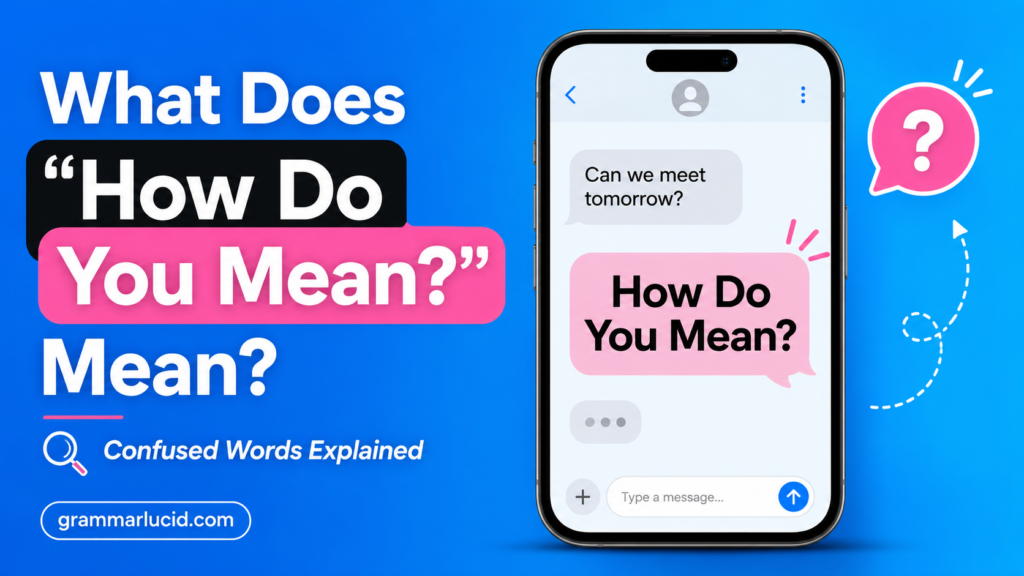
At its core, it asks someone to explain the way they mean something, not merely what they mean.
The speaker has already understood the words. What’s missing is the reasoning, interpretation, or perspective behind them.
For example:
Emma: This project isn’t ready.
David: How do you mean?
David isn’t asking Emma to repeat herself. Instead, he wants her to explain why she believes the project isn’t ready.
The phrase often invites a deeper explanation rather than a simple definition.
What the speaker is really asking
Depending on the situation, it can mean:
- Can you explain your reasoning?
- In what way do you mean that?
- Could you clarify your point?
- What makes you say that?
- How should I understand what you just said?
Although these questions overlap, each places slightly different emphasis on the explanation.
Is it Grammatically Correct?
Yes. From a grammatical standpoint, the phrase is completely correct.
Let’s break it down.
- How functions as an interrogative adverb.
- Do acts as the auxiliary verb.
- You is the subject.
- Mean is the main verb.
The sentence follows standard English question formation.
Structure:
Question word + auxiliary verb + subject + main verb
Examples include:
- How do you know?
- How do you feel?
- How do you explain that?
- How do you mean?
The grammar isn’t the reason people hesitate. The issue is usage.
Modern English overwhelmingly favors “What do you mean?” in everyday conversation. As a result, “It” may sound unfamiliar even though it is grammatically sound.
Why many learners think it’s incorrect
Many English learners depend on frequency.
If they rarely hear a phrase, they often assume it’s wrong. That’s understandable, but English doesn’t always work that way.
Many perfectly correct expressions appear less frequently because language changes over time or because certain regions prefer different wording.
For instance:
- “Shall we begin?”
- “Needn’t worry.”
- “Mightn’t.”
- “How do you mean?”
Each is grammatically acceptable, yet some occur much less often in everyday American English.
Why Does it’s Sound Unusual?
If the phrase is correct, why does it catch people off guard?
The answer lies in usage patterns rather than grammar.
Over time, native speakers began relying heavily on “What do you mean?” whenever clarification was needed. Since people hear it repeatedly, it feels familiar.
Anything less common naturally sounds unusual.
Think about clothing.
A classic black suit and a dark green suit are both appropriate for a formal event. One simply appears more often, so people notice the other.
Language works in much the same way.
Why “What do you mean?” is more common
English speakers often choose the shortest and clearest path to understanding.
Instead of asking:
How do you mean that?
Many people simply ask:
What do you mean?
The second option immediately requests clarification without drawing attention to the speaker’s thought process.
As a result, it has become the default clarification question.
Frequency shapes our expectations
People judge language partly by how often they hear it.
A phrase heard every day feels natural.
A phrase heard once a year feels unusual.
That doesn’t make the uncommon expression incorrect.
English contains thousands of perfectly acceptable words and expressions that appear only occasionally.
Uncommon doesn’t mean incorrect
Consider these examples.
| Expression | Grammatically Correct | Everyday Frequency |
| What do you mean? | ✅ | Very high |
| How do you mean? | ✅ | Moderate to low |
| Pray tell | ✅ | Very low |
| Whom did you invite? | ✅ | Low in conversation |
All four are correct.
The difference lies in how frequently speakers choose them.
“How Do You Mean?” vs. “What Do You Mean?”
This is where many learners become confused.
Although the two expressions overlap, they aren’t always interchangeable.
Core difference
“What do you mean?” asks about the meaning itself.
“How do you mean?” asks about the manner, reasoning, or interpretation behind that meaning.
Here’s an easy way to remember the distinction.
| Phrase | Focus |
| What do you mean? | Explain your meaning. |
| How do you mean? | Explain how you arrived at that meaning. |
Examples
Example 1
Sarah: Your presentation felt incomplete.
James: What do you mean?
James wants Sarah to explain exactly what she means.
Example 2
Sarah: Your presentation felt incomplete.
James: How do you mean?
James accepts the statement but wants Sarah to explain the basis for her opinion.
Example 3
Manager: This proposal isn’t practical.
Employee: How do you mean?
The employee wants details about why the manager reached that conclusion.
Comparison table
| Situation | Better Question |
| You didn’t understand the statement. | What do you mean? |
| You understood the statement but want more explanation. | How do you mean? |
| Someone made a surprising claim. | Either may work depending on context. |
| Everyday casual conversation | What do you mean? |
| Deeper discussion about ideas | How do you mean? |
When Native Speakers Actually Say “How Do You Mean?”
Although less common, native speakers still use the expression in situations that call for thoughtful clarification.
It often appears during discussions where ideas, opinions, or interpretations matter more than simple facts.
Asking someone to explain their reasoning
Imagine someone says:
“This decision could hurt the company.”
You understand every word.
What you don’t understand is why they believe it.
A natural response could be:
“How do you mean?”
The question encourages the speaker to expand their reasoning instead of repeating the original statement.
Clarifying an unexpected opinion
People sometimes make surprising observations.
For example:
“That movie wasn’t really about friendship.”
Rather than asking for a definition, you may want to hear the person’s interpretation.
In that situation, it invites a richer discussion.
Discussing opinions and interpretations
The phrase works especially well when multiple viewpoints are possible.
Examples include discussions about:
- Literature
- Art
- Politics
- Business strategy
- Personal experiences
- Philosophy
- Education
These conversations rarely have one right answer, so asking how someone means something helps uncover their perspective.
British English vs. American English usage
Regional preferences also play a role.
In British English, it appears more naturally in conversation. Speakers often use it when asking someone to expand on a statement or explain an opinion.
In American English, the phrase is much less common. Most speakers instinctively choose “What do you mean?” even when they are asking for the reasoning behind a statement.
This difference doesn’t make either version correct or incorrect. It simply reflects regional habits.
For example:
British English
“I’m not sure that’s the best approach.”
“How do you mean?”
American English
“I’m not sure that’s the best approach.”
“What do you mean?”
Both conversations communicate the same general idea, but the second version sounds more familiar to American ears.
Is it More Common in British or American English?
Regional variation is one of the biggest reasons this expression creates confusion.
Many learners consume media from both sides of the Atlantic. They may hear the phrase in a British television drama yet rarely encounter it in American movies or podcasts.
British English
British speakers are generally more comfortable using it when they want someone to elaborate on a statement.
The phrase sounds polite, conversational, and perfectly natural in many discussions.
You might hear it during:
- Workplace meetings
- Classroom discussions
- Family conversations
- Interviews
- Book clubs
- Radio programs
Because listeners are familiar with the expression, it rarely attracts attention.
American English
American speakers overwhelmingly prefer “What do you mean?” or alternatives such as:
- “What do you mean by that?”
- “How so?”
- “Can you explain?”
- “What makes you say that?”
While an American listener will usually understand it, the wording may sound slightly formal, literary, or influenced by British English rather than typical everyday speech.
That distinction is worth remembering if your goal is to sound as natural as possible for your audience.
When You Should Avoid Saying “How Do You Mean?”
Although it is grammatically correct, it isn’t always the best choice. In many situations, another clarification question sounds more natural and helps prevent confusion.
Choosing the right expression depends on your audience, the setting, and the point you want to clarify.
Situations where “What do you mean?” sounds more natural
If you simply don’t understand someone’s statement, “What do you mean?” is usually the better option.
For example:
Alex: The numbers don’t tell the whole story.
Jordan: What do you mean?
Jordan is asking Alex to explain the statement itself. Asking “How do you mean?” here wouldn’t be wrong, but it may sound less natural to many listeners, especially in the United States.
Formal writing and professional communication
In formal emails, reports, and business documents, it’s often better to avoid both expressions altogether. Instead, ask for clarification directly.
For example:
- Could you clarify your point?
- Could you elaborate on that statement?
- Would you explain your reasoning?
- Can you provide additional context?
These alternatives leave little room for misunderstanding and maintain a professional tone.
Cases where the question may confuse listeners
Some people have never heard “How do you mean?” before.
If you’re speaking with international colleagues or English learners, they may pause because they’re expecting “What do you mean?”
When clarity matters most, choose the expression your audience is most likely to recognize.
Is it Formal, Neutral, or Informal?
The phrase sits comfortably in the middle. It isn’t highly formal, nor is it especially casual.
Its tone depends more on how you say it than on the words themselves.
| Setting | Appropriate? | Notes |
| Everyday conversation | ✅ Yes | Sounds natural, especially in British English |
| Workplace discussion | ✅ Yes | Best for collaborative conversations |
| Academic discussion | ✅ Yes | Useful when exploring ideas |
| Formal business writing | ⚠️ Usually avoid | More direct wording is clearer |
| Text messages | ✅ Yes | Less common than “What do you mean?” |
Everyday conversation
Friends often ask each other to explain opinions.
Example:
Emily: That restaurant isn’t worth the price.
Ryan: How do you mean?
Ryan invites Emily to explain her opinion rather than defend it.
Workplace discussions
The phrase can encourage thoughtful discussion without sounding confrontational.
Example:
“How do you mean the proposal needs restructuring?”
The question asks for clarification while keeping the conversation constructive.
Academic and professional settings
Teachers, researchers, and students frequently discuss interpretations rather than simple facts.
For example:
“How do you mean the author’s argument changes in the final chapter?”
Here, the speaker seeks a deeper explanation instead of a simple definition.
Common Alternatives.
Sometimes another phrase fits the situation better.
Polite alternatives
- Could you explain that?
- Would you mind clarifying?
- Could you expand on that?
- Can you tell me more?
Neutral alternatives
- What do you mean?
- How so?
- What makes you say that?
- Could you elaborate?
Direct alternatives
- Explain that.
- What exactly do you mean?
- Why do you say that?
- What’s your reasoning?
Alternatives by situation
| Situation | Best Alternative |
| Business meeting | Could you elaborate? |
| Classroom discussion | Can you explain your reasoning? |
| Casual conversation | What do you mean? |
| Debate | What makes you say that? |
| Interview | Could you clarify your point? |
Choosing the right question often makes the conversation smoother than insisting on one fixed expression.
Common Mistakes English Learners Make
Many learners understand the grammar but struggle with the usage.
Recognizing these common mistakes can help you sound more natural.
Using it when asking for a definition
Incorrect:
“How do you mean ‘photosynthesis’?”
Better:
“What does ‘photosynthesis’ mean?”
Definitions require what, not how.
Replacing “What do you mean?” every time
Some learners discover “How do you mean?” and begin using it everywhere.
That creates the opposite problem.
Both expressions have their place, but “What do you mean?” remains the everyday choice for most conversations.
Assuming the phrase is incorrect
Because the expression appears less often, learners sometimes avoid it entirely.
There’s no need.
Native speakers recognize it, especially in British English. The key is using it in the right context.
Using the wrong tone
Any clarification question can sound rude if spoken impatiently.
Compare these examples.
❌ How do you mean?
✅ Sorry, how do you mean?
✅ Could you explain what you mean?
A small change in tone makes the conversation much friendlier.
Real-Life Examples
Seeing the phrase in context makes its purpose much clearer.
Everyday conversations
Olivia: I don’t think that’s the real problem.
Lucas: How do you mean?
Anna: This vacation changed my perspective.
Mark: How do you mean?
Workplace discussions
Manager: Our marketing strategy needs adjustment.
Employee: How do you mean?
Supervisor: The report feels incomplete.
Analyst: How do you mean?
Classroom conversations
Teacher: The character isn’t actually the story’s hero.
Student: How do you mean?
Customer support interactions
Customer: The software doesn’t work properly.
Support Agent: How do you mean? Could you describe what’s happening?
Here, the follow-up question encourages the customer to provide useful details.
Literature and media discussions
Book clubs and film discussions often explore interpretation rather than factual meaning.
Example:
Reader: The ending wasn’t meant to be happy.
Another reader: How do you mean?
The phrase naturally opens the door to a thoughtful explanation.
How to Reply When Someone Asks “How Do You Mean?”
If someone asks this question, they’re inviting you to explain your thinking.
A good response adds detail rather than repeating the original statement.
Brief responses
- I mean the results don’t support the conclusion.
- I’m referring to the earlier meeting.
- I think there’s another explanation.
- That’s only one part of the issue.
Detailed explanations
Instead of saying:
“The project isn’t ready.”
Try saying:
“The design is complete, but the testing phase hasn’t started. Launching now would create unnecessary risks.”
The second response answers the real question.
Professional responses
In business settings, clear explanations build trust.
Example:
“I mean the proposal meets the technical requirements, but it exceeds the client’s budget. Revising the scope would make it more practical.”
Specific details always strengthen your explanation.
Expert Tips for Choosing the Right Clarification Question
Native speakers don’t memorize rules before choosing these expressions. They simply match the question to the situation.
These practical tips can help you do the same.
Choose the question that matches your purpose
Ask yourself one question.
Am I asking about the meaning or the reasoning?
If you’re unsure what someone meant, choose:
What do you mean?
If you understand the statement but want more explanation, choose:
How do you mean?
That simple distinction solves most situations.
Consider your audience and region
If you’re speaking with Americans, “What do you mean?” will usually sound more familiar.
If you’re interacting with British speakers, hearing or using it is more likely to feel natural.
Matching your audience’s expectations makes communication easier.
Keep your tone curious rather than confrontational
Clarification questions should invite discussion, not challenge the speaker.
A calm tone encourages people to explain their ideas more openly.
Instead of sounding skeptical, try sounding interested.
That small change often leads to much better conversations.
Frequently Asked Questions (FAQs)
Q1: Is it grammatically correct?
Yes. it is grammatically correct and has long been part of the English language. Although it’s less common than “What do you mean?”, native speakers still use it, particularly when asking someone to explain their reasoning or interpretation.
Q2: What’s the difference between “How do you mean?” and “What do you mean?”
The main difference lies in the focus of the question. “What do you mean?” asks someone to explain the meaning of their statement, while “How do you mean?” asks them to explain how they arrived at that meaning or what perspective they’re expressing.
Q3: Is it common in everyday English?
It isn’t as common as “What do you mean?”, especially in American English. However, you’ll still hear it in discussions where people are exploring ideas, opinions, or interpretations rather than asking for a simple definition.
Q4: Is it more common in British English?
Yes. The phrase appears more naturally in British English than in American English. British speakers are generally more familiar with it and often use it during conversations that involve clarification or discussion.
Q5: Can I use it in professional conversations?
Yes, you can. It works well during meetings, interviews, or collaborative discussions when you want someone to explain their reasoning. In very formal writing, however, phrases like “Could you clarify?” or “Could you elaborate?” are often more appropriate.
Q6: Is it considered rude?
No. The phrase itself is polite and neutral. Whether it sounds friendly or rude depends on your tone of voice and the context. Asking it with genuine curiosity usually encourages a productive conversation.
Q7: When should I avoid saying “How do you mean?”
Avoid using it when you’re simply asking for the meaning of a word or phrase. In those cases, “What do you mean?” or “What does that mean?” is a clearer and more natural choice.
Q8: What are some good alternatives?
Several alternatives work depending on the situation, including:
- What do you mean?
- How so?
- Could you explain that?
- Could you clarify your point?
- Can you elaborate?
- What makes you say that?
Each option has a slightly different tone, so choose the one that best fits the conversation.
Q9: Will native English speakers understand “How do you mean?”
Yes. Native speakers will understand the phrase without difficulty. Even if they don’t use it regularly, they’ll recognize that you’re asking for further explanation or clarification.
Q10: Which expression should English learners use most often?
For most everyday situations, “What do you mean?” is the safest and most natural choice. Once you’re comfortable with the distinction, you can use it when you want someone to explain the reasoning or interpretation behind a statement.
Conclusion
So, is it correct to say “How do you mean?” The answer is yes. The phrase is grammatically correct and has a legitimate place in English. While it isn’t as common as “What do you mean?”, it serves a slightly different purpose by asking someone to explain the reasoning, perspective, or interpretation behind what they’ve said.
Understanding this distinction can make your conversations more precise and natural. Instead of relying on a single clarification question, choose the one that best matches the situation. If you want to know the meaning of a statement, “What do you mean?” is usually the better option. If you understand the statement but want to know how the speaker intends it or why they think that way, it fits perfectly.
The more you pay attention to context, audience, and tone, the more confident you’ll become in choosing the right expression. Small differences like these help you communicate clearly and sound more like a fluent English speaker.